Thermo-Spruce Decking
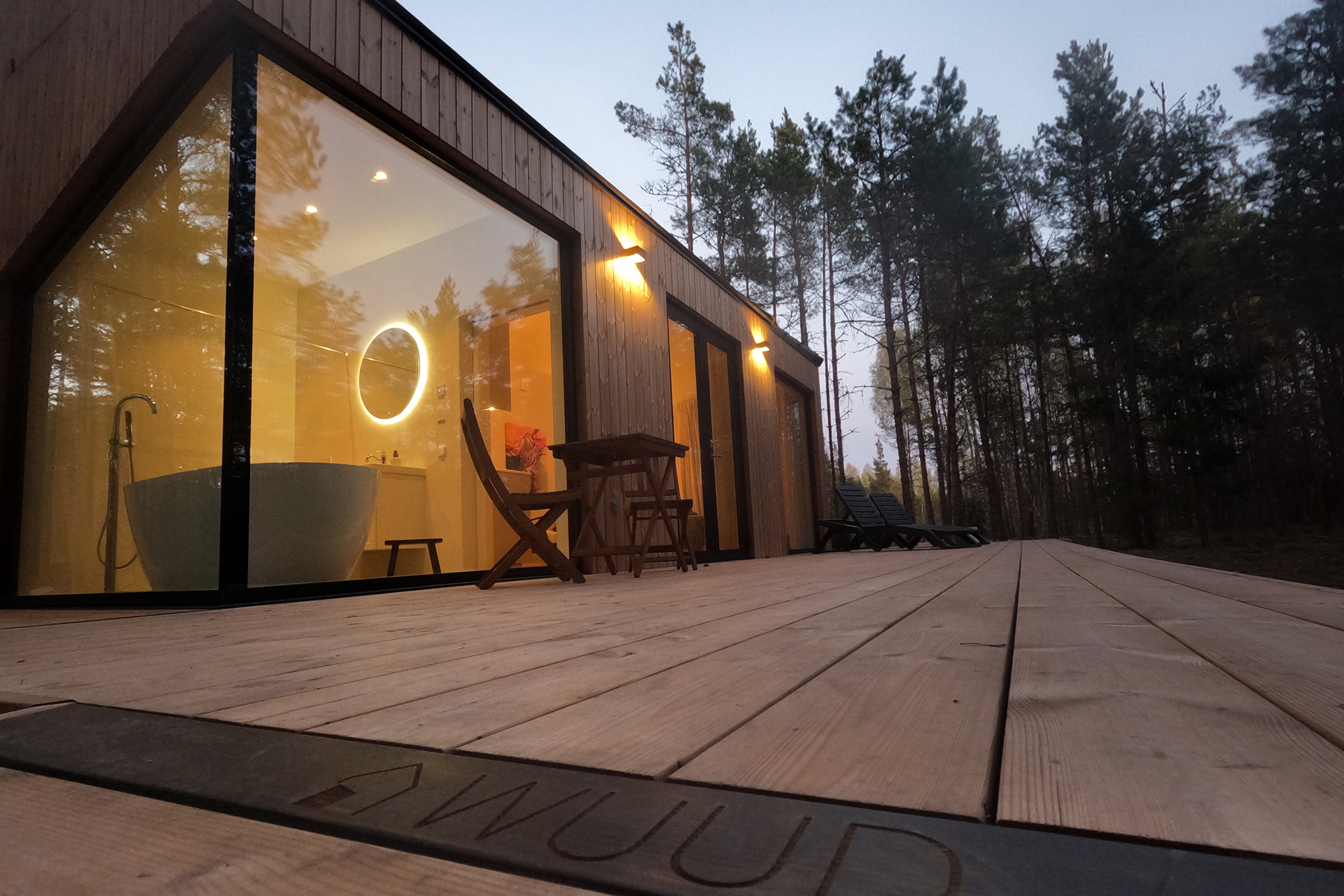
Spruce modified to durability class 1 — the same 25-year decay protection as Thermory’s ash, in a softwood. Spruce holds its knots tighter than pine and takes a more even colour, and the Kodiak collection runs it in extra-wide brushed boards where a wide-board deck is wanted without moving to hardwood. Made at Loo and Reola in Estonia from Finnish and Estonian timber.
Carbon and evidence
Product Evidence
Evidence currently held for the Thermory product record.
Recorded Carbon Result
A1–A3 GWP-total per m³ of board, per the EPD's own impact table. Negative because 739 kgCO2e of biogenic carbon is held in the timber. That store is not permanent: the same EPD declares C3 = +752 kgCO2e when the boards are processed at end of life, so cradle-to-grave is close to neutral rather than strongly negative.
Indicator: GWP-total
A1–A3 covers raw-material supply, transport to manufacture and manufacturing. It is product-stage information, not a whole-life result.
Environmental Product Declaration
EPD recorded- Coverage
- Product family
- Declared unit
- 1 m³ 413 kg
- Programme
- EPD Hub
- Registration
- HUB-4822
- Standard
- EN 15804:2012+A2:2019/AC:2021
- Valid until
- 2031-01-08
- Verification
- Third-party verified
Averaged across two manufacturing facilities (Loo and Reola, Estonia). Raw material from Finland and Estonia. Covers spruce boards used for both decking and cladding.
Carbon profile
kgCO2e per 1 m³ of board · each bar starts at zero · local scale
A1-A3 product
-564
A4-A5 site*
71.9
B use
—
C end of life
754
D reuse / recycling
-154
It stores more carbon than is emitted in making it, but the stored carbon is released again at the end of its life.
Reported GWP Modules
Displayed as stored; modules are not added together here.
A1–A3
-564 kgCO₂e
per 1 m³ of board
A4*
64.3 kgCO₂e
per 1 m³ of board
A5*
7.56 kgCO₂e
per 1 m³ of board
C1
0.164 kgCO₂e
per 1 m³ of board
C2
2.28 kgCO₂e
per 1 m³ of board
C3
752 kgCO₂e
per 1 m³ of board
C4
0 kgCO₂e
per 1 m³ of board
D
-154 kgCO₂e
per 1 m³ of board
Upfront Carbon (A1–A5)*
-492 kgCO₂e per 1 m³ of board
A1–A3 -564 + A4 64.3 + A5 7.56 · GWP-total, as declared
Sourced Product Claims
1 claim is held in the staging record but not presented as product evidence because an exact public source has not yet been mapped.
Evidence Sources
Comparison Status
This result should be displayed for information only and not ranked against another product.
- • The carbon result is not linked to an evidence source.
- • The EPD is not linked to an evidence source.
Evidence Gaps
- •1 sustainability claim is withheld because exact public evidence is not mapped.
Design & Specification Notes
Qualitative notes for early design discussion. Not product-specific EPD evidence, and not a basis for numerical comparison.
Spruce modified to durability class 1 — the same 25-year decay protection as Thermory’s ash, in a softwood.
Typical Uses
- •Paths & paving
- •Public realm surfaces
- •Permeable groundworks
Key Performance
Durable external surface with slip resistance.
Specification Actions
- •Confirm FSC or PEFC certification for all timber products.
- •Request chain-of-custody documentation from supplier.
- •Confirm the current EPD covers the selected product, finish and manufacturing route.
Indicative Health & Indoor Air
Thermal modification uses heat and steam only — no preservatives or biocides are added. Modified timber is more brittle than untreated softwood and the dust is fine; standard cutting-dust precautions apply. Specify stainless fixings — thermally modified timber is more acidic than untreated wood and will stain around plain steel.
Specification
- Range
- Thermo-spruce decking
- Collection
- Benchmark
- Finish
- Thermally modified spruce deck board
- Country of manufacture
- Estonia