Thermo-Ash Cladding
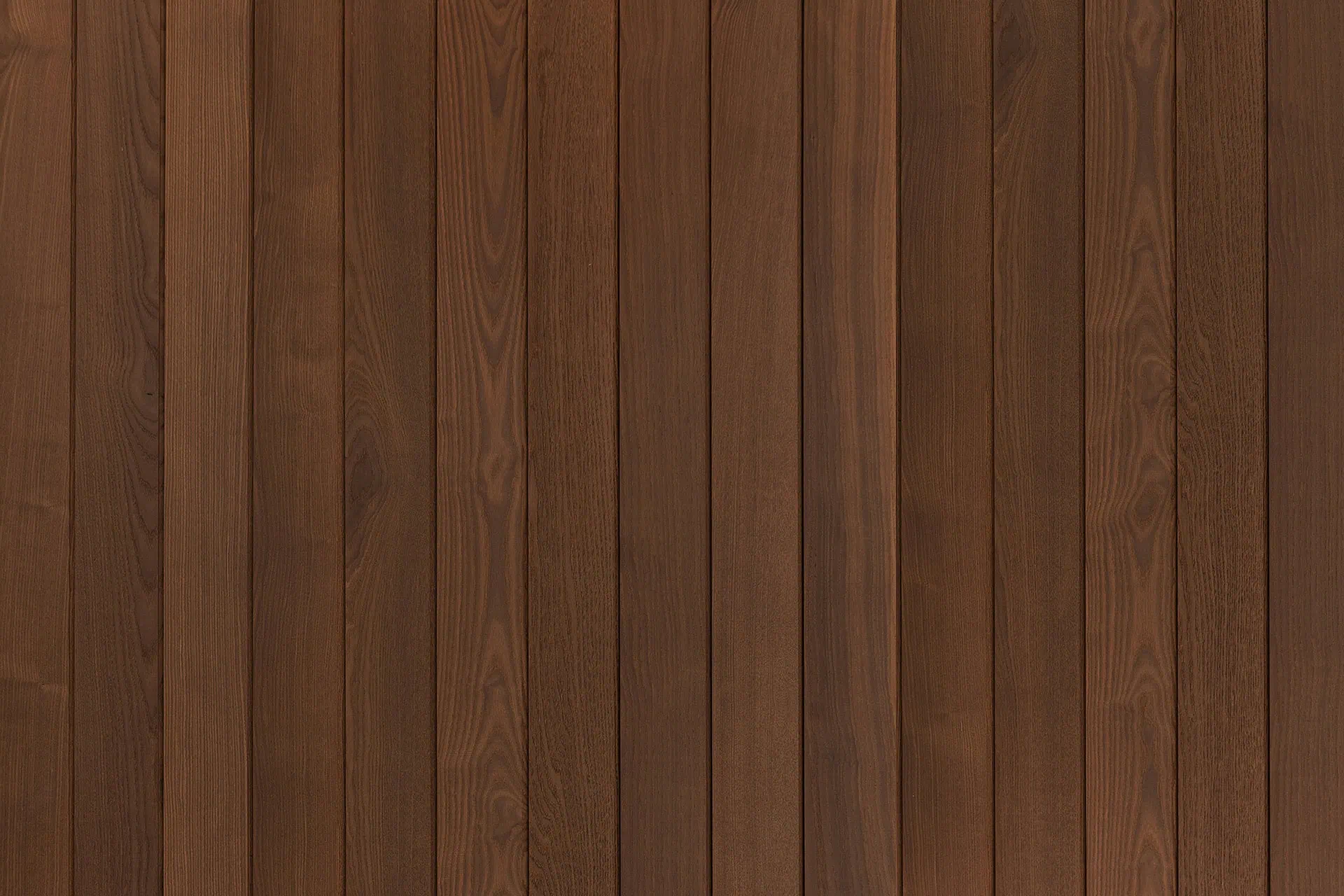
Thermally modified ash — the densest board Thermory make and the darkest, a deep even brown right through the section, with the tight grain and smooth finish that reads as a hardwood rather than a treated softwood. Durability class 1 without preservatives, which puts it alongside tropical hardwoods for external use. Made at Thermory’s Loo and Reola mills in Estonia.
Carbon and evidence
Product Evidence
Evidence currently held for the Thermory product record.
Recorded Carbon Result
A1–A3 GWP-total per m³ of board, per the EPD's own impact table. Negative because 1090 kgCO2e of biogenic carbon is held in the timber. That store is not permanent: the same EPD declares C3 = +1110 kgCO2e when the boards are processed at end of life, so cradle-to-grave is close to neutral rather than strongly negative.
Indicator: GWP-total
A1–A3 covers raw-material supply, transport to manufacture and manufacturing. It is product-stage information, not a whole-life result.
Environmental Product Declaration
EPD recorded- Coverage
- Product family
- Declared unit
- 1 m³ 608 kg
- Programme
- EPD Hub
- Registration
- HUB-4823
- Standard
- EN 15804:2012+A2:2019/AC:2021
- Valid until
- 2031-01-08
- Verification
- Third-party verified
This is the "premium boards" declaration, a weighted average across ash, oak, magnolia and radiata pine from two Estonian factories — not an ash-only figure. Ash is the volume species and the one this record describes; a project specifying oak or magnolia is covered by the same declaration but its individual figure will differ from the −771 average. Raw material origin spans Estonia, Austria, Germany, France, Ukraine, the United States, Czechia, Hungary, Sweden and New Zealand. 61.1% of A1–A3 is manufacturer-specific data.
Carbon profile
kgCO2e per 1 m³ of board · each bar starts at zero · local scale
A1-A3 product
-771
A4-A5 site*
100
B use
—
C end of life
1114
D reuse / recycling
-222
It stores more carbon than is emitted in making it, but the stored carbon is released again at the end of its life.
Reported GWP Modules
Displayed as stored; modules are not added together here.
A1–A3
-771 kgCO₂e
per 1 m³ of board
A4*
94.4 kgCO₂e
per 1 m³ of board
A5*
5.82 kgCO₂e
per 1 m³ of board
C1
0.241 kgCO₂e
per 1 m³ of board
C2
3.27 kgCO₂e
per 1 m³ of board
C3
1110 kgCO₂e
per 1 m³ of board
C4
0 kgCO₂e
per 1 m³ of board
D
-222 kgCO₂e
per 1 m³ of board
Upfront Carbon (A1–A5)*
-671 kgCO₂e per 1 m³ of board
A1–A3 -771 + A4 94.4 + A5 5.82 · GWP-total, as declared
Sourced Product Claims
2 claims are held in the staging record but not presented as product evidence because an exact public source has not yet been mapped.
Evidence Sources
Comparison Status
This result should be displayed for information only and not ranked against another product.
- • The carbon result is not linked to an evidence source.
- • The EPD is not linked to an evidence source.
Evidence Gaps
- •2 sustainability claims are withheld because exact public evidence is not mapped.
Design & Specification Notes
Qualitative notes for early design discussion. Not product-specific EPD evidence, and not a basis for numerical comparison.
Thermally modified ash — the densest board Thermory make and the darkest, a deep even brown right through the section, with the tight grain and smooth finish that reads as a hardwood rather than a treated softwood.
Typical Uses
- •Facade cladding
- •Weather protection
- •External accents
Key Performance
Weather-resistant finish for facade exposure.
Typical Service-Life Estimate
40 yearsGeneric estimate for early design discussion; confirm with the manufacturer.
Specification Actions
- •Confirm FSC or PEFC certification for all timber products.
- •Request chain-of-custody documentation from supplier.
- •Confirm the current EPD covers the selected product, finish and manufacturing route.
Indicative Health & Indoor Air
Thermal modification uses heat and steam only — no preservatives or biocides are added. Modified timber is more brittle than untreated softwood and the dust is fine; standard cutting-dust precautions apply.
Specification
- Range
- Thermo-ash cladding
- Collection
- Benchmark
- Finish
- Thermally modified ash board
- Country of manufacture
- Estonia