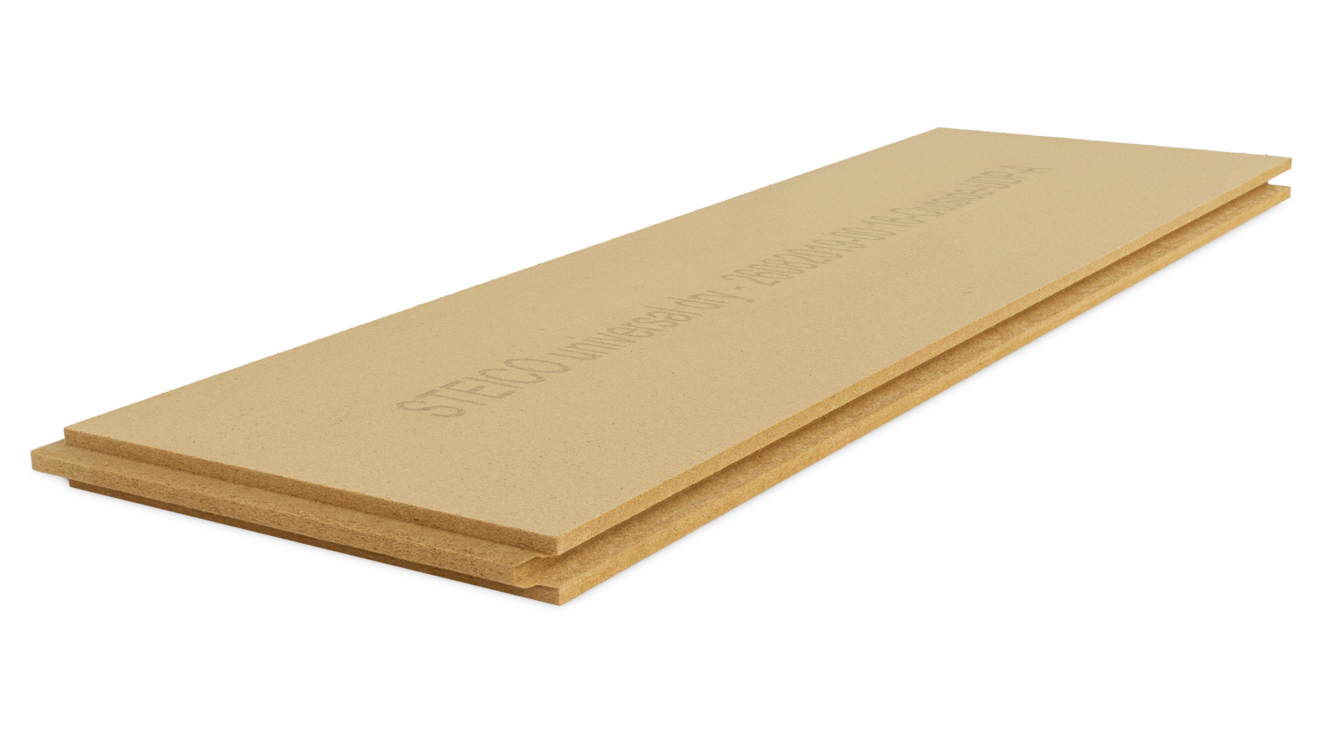
STEICOuniversal dry
A rigid dry-process wood fibre board — combined sarking, sheathing and render-carrier board — the denser sibling for direct render systems. Dry-process boards are denser and stiffer than the flexible batts, bonded with a small PMDI resin content rather than heat-felted, and they weatherproof a timber frame during construction while adding decrement delay the lightweight alternatives cannot. The declaration is per cubic metre and negative at A1–A3 only because the stored biogenic carbon outweighs production emissions; C3 hands 357 kgCO2e back if the board is incinerated at end of life.
Carbon and evidence
Product Evidence
Evidence currently held for the STEICO product record.
Recorded Carbon Result
A1–A3 GWP-total per m³ of board (210 kg). Negative because 363 kgCO2e of biogenic carbon is held in the fibre against 161 of fossil emissions. The store is not permanent: C3 declares +357 kgCO2e when the board is incinerated at end of life, so cradle-to-grave is close to neutral.
Indicator: GWP-total
A1–A3 covers raw-material supply, transport to manufacture and manufacturing. It is product-stage information, not a whole-life result.
Environmental Product Declaration
EPD recorded- Coverage
- Specific product
- Declared unit
- 1 m³ 210 kg
- Programme
- EPD Global / EPD Norge
- Registration
- NEPD-11389-11389-2
- Standard
- EN 15804:2012+A2:2019
- Valid until
- 2031-04-07
- Verification
- Third-party verified
Product-specific declaration, year of study 2024.
Carbon profile
kgCO2e per 1 m³ of board (210 kg) · each bar starts at zero · local scale
A1-A3 product
-202
A4-A5 site*
6.97
B use
—
C end of life
358
D reuse / recycling
-150
It stores more carbon than is emitted in making it, but the stored carbon is released again at the end of its life.
Reported GWP Modules
Displayed as stored; modules are not added together here.
A1–A3
-202 kgCO₂e
per 1 m³ of board (210 kg)
A4*
6.97 kgCO₂e
per 1 m³ of board (210 kg)
C1
0 kgCO₂e
per 1 m³ of board (210 kg)
C2
1.09 kgCO₂e
per 1 m³ of board (210 kg)
C3
357 kgCO₂e
per 1 m³ of board (210 kg)
C4
0 kgCO₂e
per 1 m³ of board (210 kg)
D
-150 kgCO₂e
per 1 m³ of board (210 kg)
Evidence Sources
EPD Global / EPD Norge
Comparison Status
This result should be displayed for information only and not ranked against another product.
- • The carbon result is not linked to an evidence source.
- • The EPD is not linked to an evidence source.
Design & Specification Notes
Qualitative notes for early design discussion. Not product-specific EPD evidence, and not a basis for numerical comparison.
A rigid dry-process wood fibre board — combined sarking, sheathing and render-carrier board — the denser sibling for direct render systems.
Typical Uses
- •Thermal envelope
- •Roof/wall cavities
- •Airtightness layers
Key Performance
Good thermal resistance with reduced heat loss.
Typical Service-Life Estimate
60 yearsGeneric estimate for early design discussion; confirm with the manufacturer.
Specification Actions
- •Compare embodied carbon of insulation options (natural vs synthetic).
- •Request blowing agent GWP values for foam insulation.
- •Confirm the current EPD covers the selected product, finish and manufacturing route.
Indicative Health & Indoor Air
Specification
- Finish
- Rigid tongue-and-groove wood fibre render-carrier board
- Country of manufacture
- Poland