Kvillsfors Fixed Frame, Alu-Clad + ORAÉ
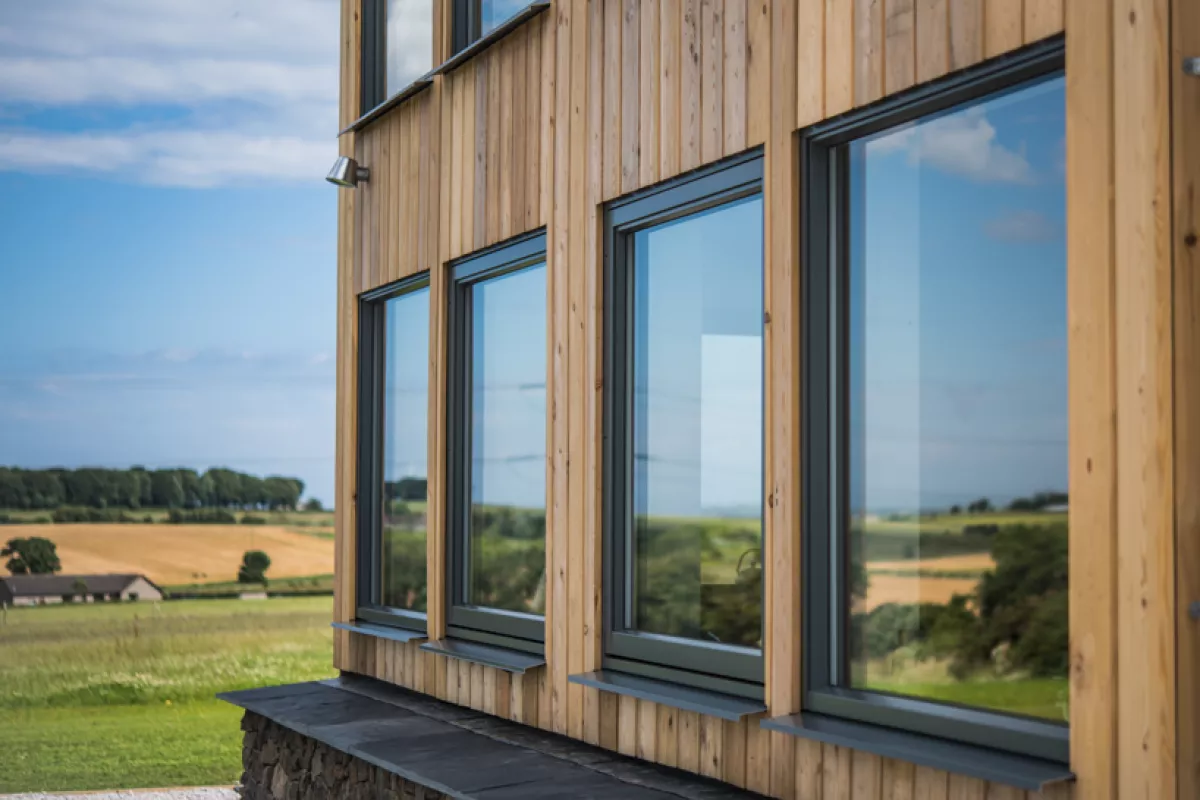
A fixed light from NorDan’s Swedish Kvillsfors line — laminated timber frame, external aluminium cladding, and Saint-Gobain’s ORAÉ reduced-carbon glass, which is what pulls the declared production figure down to 50 kgCO2e for a reference-size window. The declaration is unusually honest about the use stage: maintenance over the 60-year service life is declared at +46 kgCO2e — nearly production again — which is the real argument for the alu-cladding that removes the repainting cycle a bare timber window needs.
Carbon and evidence
Product Evidence
Evidence currently held for the NorDan product record.
Recorded Carbon Result
A1–A3 GWP-total for one 1.23 × 1.48 m reference window (78 fossil less 28.2 biogenic held in the timber frame). Not comparable per-m² with curtain walling — window EPDs declare per piece. The use stage matters here: declared B2 maintenance adds +46 kgCO2e over the 60-year life.
Indicator: GWP-total
A1–A3 covers raw-material supply, transport to manufacture and manufacturing. It is product-stage information, not a whole-life result.
Environmental Product Declaration
EPD recorded- Coverage
- Specific product
- Declared unit
- 1 window, 1.23 m × 1.48 m (EN 14351-1 reference size), 60-year service life
- Programme
- EPD Norge (The Norwegian EPD Foundation)
- Registration
- NEPD-9651-9288
- Standard
- EN 15804:2012+A2:2019, ISO 14025
- Valid until
- 2030-04-08
- Verification
- Third-party verified
Product-specific declaration for the Kvillsfors-made window with aluminium cladding and Saint-Gobain ORAÉ® reduced-carbon glass. Year of study 2020.
Carbon profile
kgCO2e per 1 reference window (1.23 × 1.48 m) · each bar starts at zero · local scale
A1-A3 product
50
A4-A5 site*
8.48
B use
46
C end of life
33.5
D reuse / recycling
-4.54
Reported GWP Modules
Displayed as stored; modules are not added together here.
A1–A3
50 kgCO₂e
per 1 reference window (1.23 × 1.48 m)
A4*
3.02 kgCO₂e
per 1 reference window (1.23 × 1.48 m)
A5*
5.46 kgCO₂e
per 1 reference window (1.23 × 1.48 m)
B2
46 kgCO₂e
per 1 reference window (1.23 × 1.48 m)
B4
0 kgCO₂e
per 1 reference window (1.23 × 1.48 m)
C1
0 kgCO₂e
per 1 reference window (1.23 × 1.48 m)
C2
0.456 kgCO₂e
per 1 reference window (1.23 × 1.48 m)
C3
32.5 kgCO₂e
per 1 reference window (1.23 × 1.48 m)
C4
0.533 kgCO₂e
per 1 reference window (1.23 × 1.48 m)
D
-4.54 kgCO₂e
per 1 reference window (1.23 × 1.48 m)
Upfront Carbon (A1–A5)*
58.5 kgCO₂e per 1 reference window (1.23 × 1.48 m)
A1–A3 50 + A4 3.02 + A5 5.46 · GWP-total, as declared
Service Life — the B4 Replacement Input
60 years · EPD reference service life
The declared functional unit carries a 60-year expected service life; the EPD then declares real maintenance carbon (B2) across that life, which is why the use stage appears in the modules rather than being quietly omitted.
≈1 installation over a 60-year building study period.
Evidence Sources
EPD Norge (The Norwegian EPD Foundation)
Comparison Status
This result should be displayed for information only and not ranked against another product.
- • The carbon result is not linked to an evidence source.
- • The EPD is not linked to an evidence source.
Design & Specification Notes
Qualitative notes for early design discussion. Not product-specific EPD evidence, and not a basis for numerical comparison.
A fixed light from NorDan’s Swedish Kvillsfors line — laminated timber frame, external aluminium cladding, and Saint-Gobain’s ORAÉ reduced-carbon glass, which is what pulls the declared production figure down to 50 kgCO2e for a reference-size window.
Typical Uses
- •Glazing systems
- •Daylight openings
- •Thermal envelope
Key Performance
Supports daylight and thermal performance of the envelope.
Specification Actions
- •Confirm FSC or PEFC certification for all timber products.
- •Request chain-of-custody documentation from supplier.
- •Verify glazing U-values meet or exceed building regs.
Indicative Health & Indoor Air
Specification
- Range
- Kvillsfors
- Finish
- Alu-clad timber window, fixed light
- Service life
- 60 years
- Country of manufacture
- Sweden