Marshalls Indian Sandstone
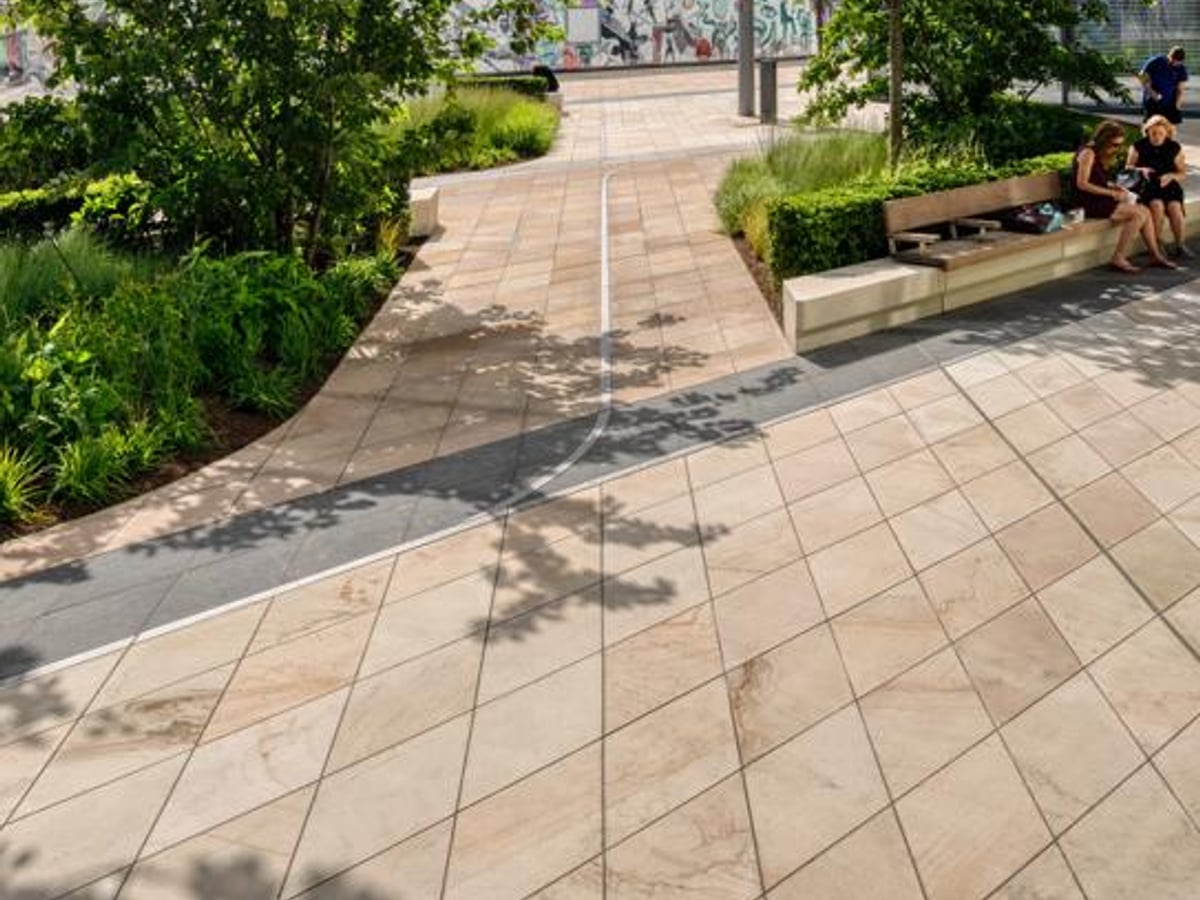
Natural Indian sandstone paving (Fairstone range) — quarried, sawn or riven flags for patios and public realm. Cradle-to-gate carbon (A1–A3) is low, but module A4 shows that sea/road transport from India roughly doubles the cradle-to-site figure — the dominant impact for imported stone.
Carbon and evidence
Product Evidence
Evidence currently held for the Marshalls product record.
Recorded Carbon Result
A1–A3 GWP-total per declared unit, per EPD
Indicator: GWP-total
Marshalls Indian Sandstone Environmental Product Declaration · EN 15804+A2 core environmental impact indicatorsA1–A3 covers raw-material supply, transport to manufacture and manufacturing. It is product-stage information, not a whole-life result.
Environmental Product Declaration
EPD recorded- Coverage
- Product family
- Declared unit
- 1 tonne (1000 kg)
- Programme
- EPD Hub
- Registration
- EPD Hub HUB-2473
- Standard
- EN 15804+A2
- Valid until
- 2030-02-20
- Verification
- Third-party verified
Family EPD for imported Indian sandstone paving (Brackendale, Brownridge, Laurelbank, Hawksview, Thornlake); declared per tonne of stone.
Carbon profile
kgCO2e per 1 tonne (1000 kg) · each bar starts at zero · local scale
A1-A3 product
209
A4-A5 site*
266
B use
—
C end of life
4.21
D reuse / recycling
-25.8
Transport and installation scenarios are the largest of the modules this EPD declares.
Reported GWP Modules
Displayed as stored; modules are not added together here.
A1–A3
209 kgCO₂e
per 1 tonne (1000 kg)
A4*
213 kgCO₂e
per 1 tonne (1000 kg)
A5*
53.4 kgCO₂e
per 1 tonne (1000 kg)
C1
3.18 kgCO₂e
per 1 tonne (1000 kg)
C2
0.657 kgCO₂e
per 1 tonne (1000 kg)
C3
0 kgCO₂e
per 1 tonne (1000 kg)
C4
0.369 kgCO₂e
per 1 tonne (1000 kg)
D
-25.8 kgCO₂e
per 1 tonne (1000 kg)
Upfront Carbon (A1–A5)*
475 kgCO₂e per 1 tonne (1000 kg)
A1–A3 209 + A4 213 + A5 53.4 · GWP-total, as declared
Service Life — the B4 Replacement Input
100 years · EPD reference service life
≈1 installation over a 60-year building study period.
Evidence Sources
EPD Hub · EN 15804+A2 core environmental impact indicators
Coverage: Family EPD for imported Indian sandstone paving (Brackendale, Brownridge, Laurelbank, Hawksview, Thornlake); declared per tonne of stone.
Comparison Status
The record contains the basic metadata required for a controlled comparison. Products must still perform the same function and use compatible units, PCRs and lifecycle scope.
Design & Specification Notes
Qualitative notes for early design discussion. Not product-specific EPD evidence, and not a basis for numerical comparison.
Natural Indian sandstone paving (Fairstone range) — quarried, sawn or riven flags for patios and public realm.
Typical Uses
- •Paths & paving
- •Public realm surfaces
- •Permeable groundworks
Key Performance
Durable external surface with slip resistance.
Specification Actions
- •Confirm the current EPD covers the selected product, finish and manufacturing route.
- •Calculate transport distances for primary materials.
- •Document material reuse or reclaimed content percentages.
Indicative Health & Indoor Air
Inert natural stone; standard silica-dust precautions when cutting.
Specification
- Range
- Natural Sandstone (Fairstone)
- Collection
- Natural Stone Hard Landscaping
- Finish
- Natural Indian sandstone paving
- Service life
- 100 years