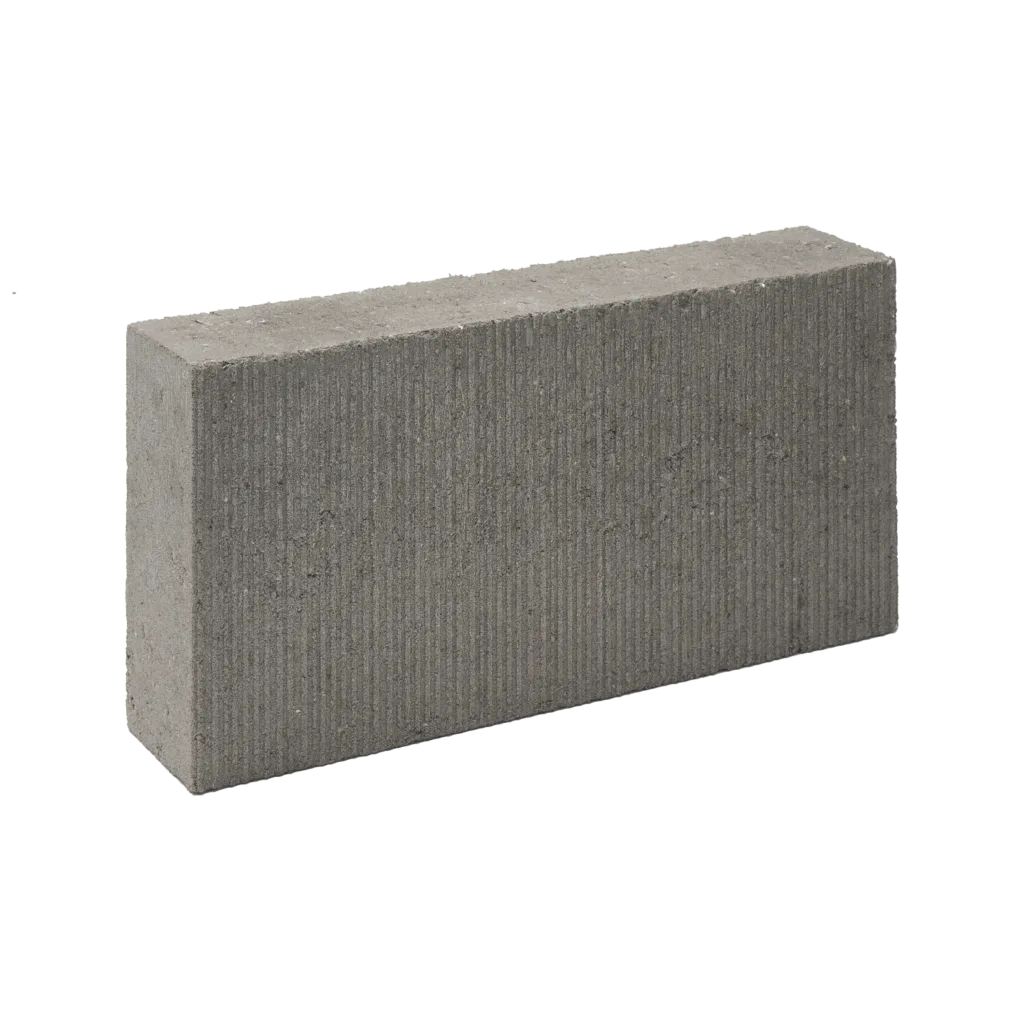
Lignacite GP 7.3N
Their general-purpose block, made with pulverised fuel ash and biomass in the mix — and on their own declarations the lowest-carbon block they make, at 11.9 kgCO₂e/m² of wall. That figure is net: 24.3 of fossil emissions less 12.5 of biogenic carbon held in the organic content. The store is a loan, not a removal — module C3 returns +10.5 when the block is crushed at end of life — so the honest reading is a low-fossil block rather than a carbon sink.
Carbon and evidence
Product Evidence
Evidence currently held for the Lignacite product record.
Recorded Carbon Result
A1–A3 GWP-total per m² of 100 mm wall (162.65 kg), net of 12.5 kgCO2e of biogenic carbon in the mix against 24.3 of fossil emissions — a store the declaration returns as +10.5 at C3. Carbonation adds a further declared -1.5 in use (B1).
Indicator: GWP-total
Lignacite GP 7.3N (HUB-0105)A1–A3 covers raw-material supply, transport to manufacture and manufacturing. It is product-stage information, not a whole-life result.
Environmental Product Declaration
EPD recorded- Coverage
- Specific product
- Declared unit
- 1 m² 100 mm block wall, 162.65 kg
- Programme
- EPD Hub
- Registration
- HUB-0105
- Standard
- EN 15804:2012+A2:2019, ISO 14025, ISO 21930
- Valid until
- 2027-08-17
- Verification
- Third-party verified
Lignacite GP 7.3N, 7.3 N/mm², 100 mm. Declared per square metre of wall, so it is directly comparable with Lignacite’s other blocks.
Carbon profile
kgCO2e per 1 m² of 100 mm wall · each bar starts at zero · local scale
A1-A3 product
11.9
A4-A5 site*
0.792
B use
-1.5
C end of life
14.5
D reuse / recycling
-1.04
End of life is the largest of the modules this EPD declares.
Reported GWP Modules
Displayed as stored; modules are not added together here.
A1–A3
11.9 kgCO₂e
per 1 m² of 100 mm wall
A4*
0.768 kgCO₂e
per 1 m² of 100 mm wall
A5*
0.0243 kgCO₂e
per 1 m² of 100 mm wall
B1
-1.5 kgCO₂e
per 1 m² of 100 mm wall
C1
0.538 kgCO₂e
per 1 m² of 100 mm wall
C2
0.75 kgCO₂e
per 1 m² of 100 mm wall
C3
10.5 kgCO₂e
per 1 m² of 100 mm wall
C4
2.67 kgCO₂e
per 1 m² of 100 mm wall
D
-1.04 kgCO₂e
per 1 m² of 100 mm wall
Upfront Carbon (A1–A5)*
12.7 kgCO₂e per 1 m² of 100 mm wall
A1–A3 11.9 + A4 0.768 + A5 0.0243 · GWP-total, as declared
Service Life — the B4 Replacement Input
100 years · EPD reference service life
The declaration states a 100-year reference service life.
≈1 installation over a 60-year building study period.
Evidence Sources
EPD Hub
Comparison Status
This result should be displayed for information only and not ranked against another product.
- • The EPD is not linked to an evidence source.
Design & Specification Notes
Qualitative notes for early design discussion. Not product-specific EPD evidence, and not a basis for numerical comparison.
Their general-purpose block, made with pulverised fuel ash and biomass in the mix — and on their own declarations the lowest-carbon block they make, at 11.
Typical Uses
- •Primary frame
- •Long-span elements
- •Load-bearing supports
Key Performance
High load-bearing capacity for primary frame.
Specification Actions
- •Specify GGBS/PFA cement replacement (target: 50%+ replacement).
- •Request EPD showing embodied carbon per m3.
- •Calculate transport distances for primary materials.
Indicative Health & Indoor Air
Specification
- Range
- Lignacite GP
- Finish
- General-purpose ash aggregate block, 100 mm
- Thickness
- 100 mm
- Service life
- 100 years
- Country of manufacture
- United Kingdom