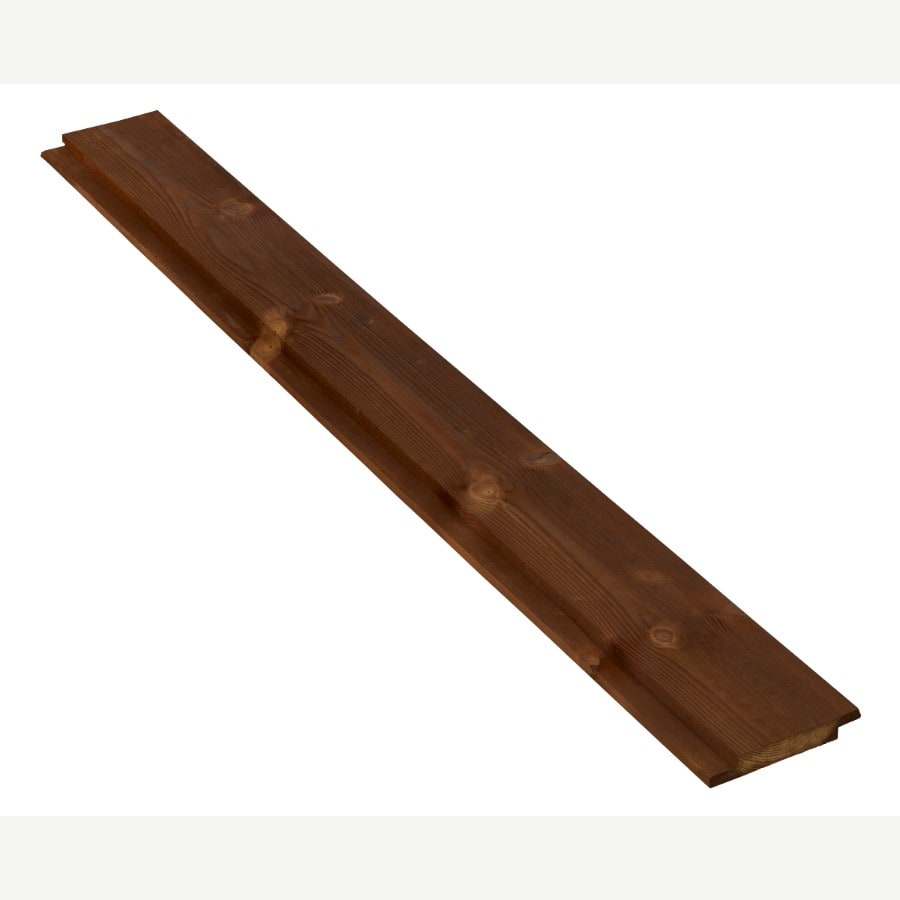
Kebony Character Cladding
Scots pine impregnated with furfuryl alcohol — a bio-based chemistry derived from agricultural crop waste — then cured, permanently thickening the cell walls so a fast-grown softwood behaves like a durable hardwood: Kebony quote class 1 durability and use it uncoated, weathering to silver-grey. Character is the knotty grade cut from the whole log. The modification is chemical rather than thermal, so unlike thermally modified timber it adds real fossil carbon in production (+231 kgCO2e/m³) — but the timber’s biogenic store still dominates the declared A1–A3.
Carbon and evidence
Product Evidence
Evidence currently held for the Kebony product record.
Recorded Carbon Result
A1–A3 GWP-total per m³ (570 kg). Negative because 1,050 kgCO2e of biogenic carbon is held in the timber against 231 of fossil emissions from the furfurylation process — roughly double the fossil carbon of the thermally modified pines on this shelf, bought back many times over by the biogenic store. That store is not permanent: C3 declares +1,060 kgCO2e at end-of-life incineration, so cradle-to-grave is close to neutral rather than strongly negative.
Indicator: GWP-total
A1–A3 covers raw-material supply, transport to manufacture and manufacturing. It is product-stage information, not a whole-life result.
Environmental Product Declaration
EPD recorded- Coverage
- Specific product
- Declared unit
- 1 m³ 570 kg/m³
- Programme
- EPD Norge (The Norwegian EPD Foundation)
- Registration
- NEPD-3513-2106-EN
- Standard
- EN 15804:2012+A2:2019, ISO 14025
- Valid until
- 2027-05-25
- Verification
- Third-party verified
Kebony Character (Scots Pine) cladding produced at Skien, Norway. Selected key indicators were revised in March 2025.
Carbon profile
kgCO2e per 1 m³ of cladding (570 kg) · each bar starts at zero · local scale
A1-A3 product
-812
A4-A5 site*
41.5
B use
—
C end of life
1068
D reuse / recycling
-692
It stores more carbon than is emitted in making it, but the stored carbon is released again at the end of its life.
Reported GWP Modules
Displayed as stored; modules are not added together here.
A1–A3
-812 kgCO₂e
per 1 m³ of cladding (570 kg)
A4*
38.7 kgCO₂e
per 1 m³ of cladding (570 kg)
A5*
2.75 kgCO₂e
per 1 m³ of cladding (570 kg)
C1
0.0656 kgCO₂e
per 1 m³ of cladding (570 kg)
C2
7.84 kgCO₂e
per 1 m³ of cladding (570 kg)
C3
1060 kgCO₂e
per 1 m³ of cladding (570 kg)
C4
0.0977 kgCO₂e
per 1 m³ of cladding (570 kg)
D
-692 kgCO₂e
per 1 m³ of cladding (570 kg)
Upfront Carbon (A1–A5)*
-771 kgCO₂e per 1 m³ of cladding (570 kg)
A1–A3 -812 + A4 38.7 + A5 2.75 · GWP-total, as declared
Sourced Product Claims
- Modified with furfuryl alcohol derived from agricultural crop waste — no biocides or heavy metalsManufacturer declaredSource
- Stores 1,050 kgCO2e/m³ biogenic carbon, releases 1,060 at end of lifeThird-party verifiedSource
- Third-party verified EPD, valid to 2027-05-25 — expiring, re-check due spring 2027Third-party verifiedSource
Evidence Sources
EPD Norge (The Norwegian EPD Foundation)
Comparison Status
This result should be displayed for information only and not ranked against another product.
- • The carbon result is not linked to an evidence source.
- • The EPD is not linked to an evidence source.
Design & Specification Notes
Qualitative notes for early design discussion. Not product-specific EPD evidence, and not a basis for numerical comparison.
Scots pine impregnated with furfuryl alcohol — a bio-based chemistry derived from agricultural crop waste — then cured, permanently thickening the cell walls so a fast-grown softwood behaves like a durable hardwood: Kebony quote class 1 durability and use it uncoated, weathering to silver-grey.
Typical Uses
- •Facade cladding
- •Weather protection
- •External accents
Key Performance
Weather-resistant finish for facade exposure.
Typical Service-Life Estimate
40 yearsGeneric estimate for early design discussion; confirm with the manufacturer.
Specification Actions
- •Confirm FSC or PEFC certification for all timber products.
- •Request chain-of-custody documentation from supplier.
- •Confirm the current EPD covers the selected product, finish and manufacturing route.
Indicative Health & Indoor Air
Specification
- Range
- Kebony Character
- Finish
- Furfurylated Scots pine cladding, knotty grade
- Country of manufacture
- Norway