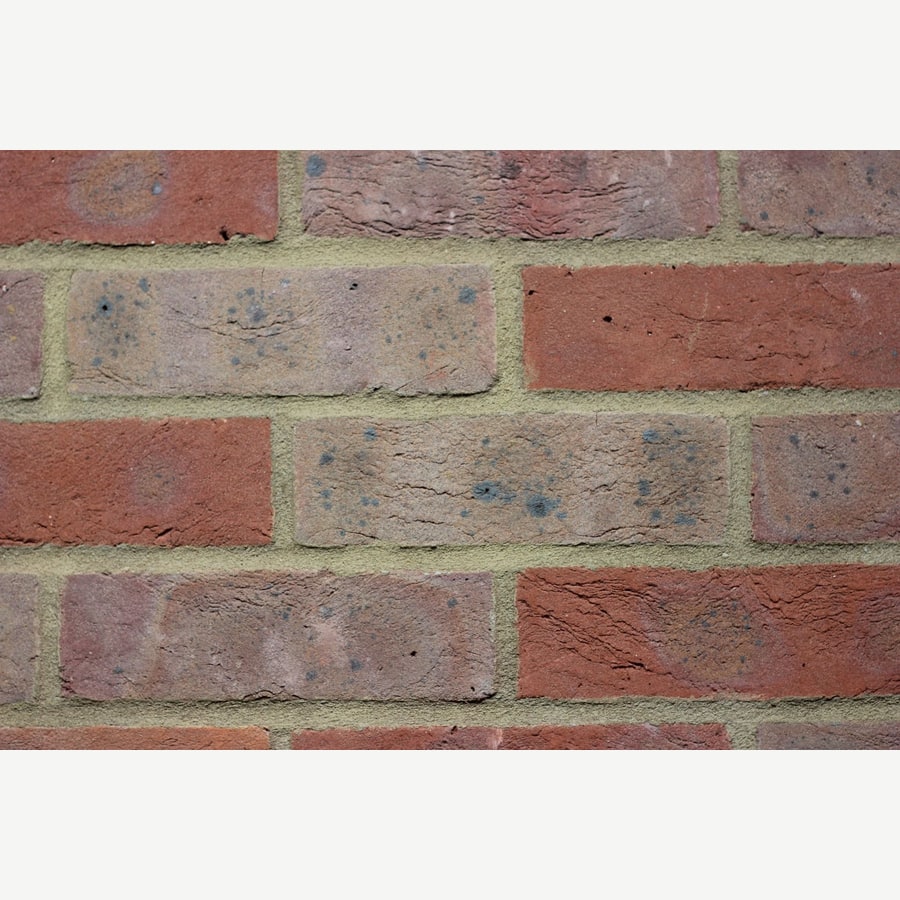
Handmade Brick (Oil & Anthracite Fired)
The conventionally fired handmade and machine-made bricks — the same clay and the same hands as the wood-fired range, taken through an oil and anthracite kiln instead. At 270 kgCO₂e per tonne against 106 for the wood-fired version — the same clay, the same hands, a different kiln — it is the fuel rather than the clay that sets a brick’s carbon.
Carbon and evidence
Product Evidence
Evidence currently held for the HG Matthews product record.
Recorded Carbon Result
A1–A3 GWP-total per tonne of brick. GWP-fossil is 269. Whole-life A1–A3 plus C modules is 279.4. For scale, UK independents in this catalogue run from −15.4 (an unfired earth block) through 106 for a wood-fired brick to 697 for a Hoffman-kiln handmade one — "clay brick" is not one number, and the firing route is what sets it.
Indicator: GWP-total
Handmade Brick (Oil & Anthracite Fired) (NEPD-10625-10625-2)A1–A3 covers raw-material supply, transport to manufacture and manufacturing. It is product-stage information, not a whole-life result.
Environmental Product Declaration
EPD recorded- Coverage
- Product family
- Declared unit
- 1 tonne (declared unit mass 1000 kg)
- Programme
- EPD Global (The Norwegian EPD Foundation)
- Registration
- NEPD-10625-10625-2
- Standard
- EN 15804:2012+A2:2019
- Valid until
- 2030-11-18
- Verification
- Third-party verified
Made at Bellingdon, Buckinghamshire.
Reported GWP Modules
Displayed as stored; modules are not added together here.
A1–A3
270 kgCO₂e
per 1 tonne
Service Life — the B4 Replacement Input
150 years · EPD reference service life
The declaration states a 150-year reference service life.
≈1 installation over a 60-year building study period.
Sourced Product Claims
- Third-party verified EPD, valid to 2030-11-18Third-party verifiedSource
Evidence Sources
EPD Global (The Norwegian EPD Foundation)
Comparison Status
This result should be displayed for information only and not ranked against another product.
- • The EPD is not linked to an evidence source.
Design & Specification Notes
Qualitative notes for early design discussion. Not product-specific EPD evidence, and not a basis for numerical comparison.
The conventionally fired handmade and machine-made bricks — the same clay and the same hands as the wood-fired range, taken through an oil and anthracite kiln instead.
Typical Uses
- •Facade cladding
- •Weather protection
- •External accents
Key Performance
Weather-resistant finish for facade exposure.
Specification Actions
- •Confirm the current EPD covers the selected product, finish and manufacturing route.
- •Calculate transport distances for primary materials.
- •Document material reuse or reclaimed content percentages.
Indicative Health & Indoor Air
Specification
- Range
- Handmade Brick (Oil & Anthracite Fired)
- Finish
- Clay facing brick, oil and anthracite fired
- Service life
- 150 years
- Country of manufacture
- United Kingdom