Gypsum Fibre Board
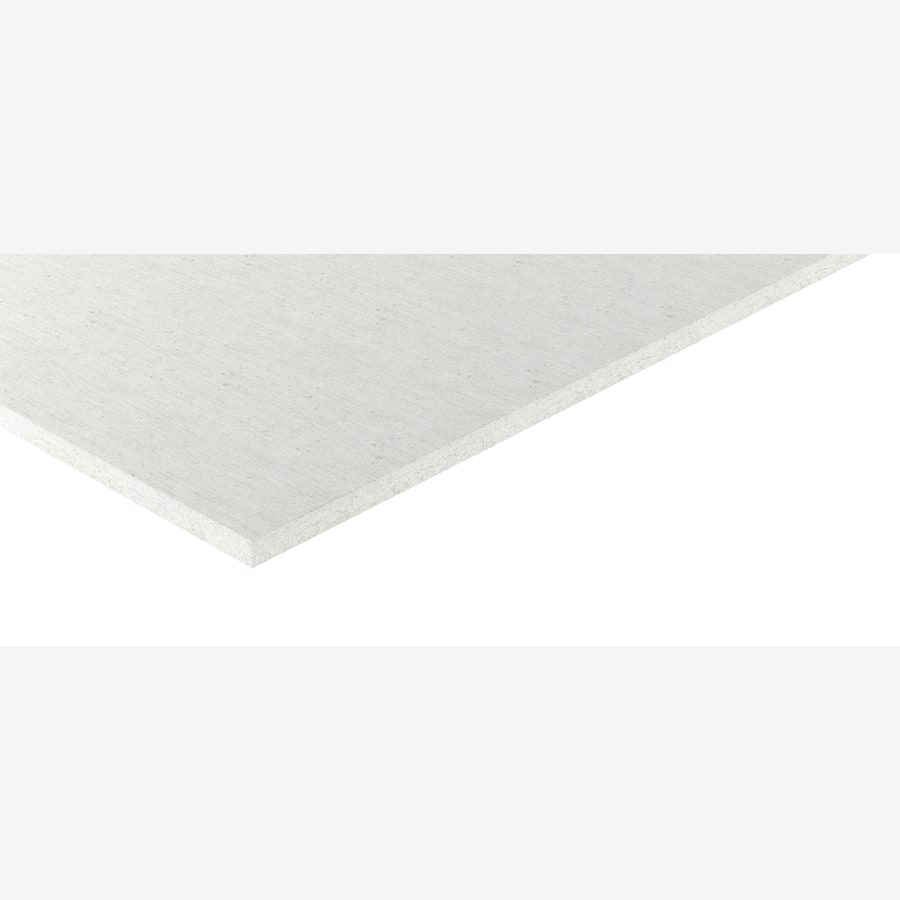
A drylining board made from recycled gypsum (largely FGD and recycled plasterboard) reinforced through its full thickness with recycled paper fibre — no paper liners, so it takes screws and impacts a standard plasterboard cannot, and one board does the job of plasterboard-plus-ply in many partitions. The paper content makes it mildly carbon-negative at the factory gate (−0.46 kgCO2e/m²); the declaration is equally clear that landfilling releases +3.44 back as the paper decomposes, so the end-of-life route decides whether the store holds.
Carbon and evidence
Product Evidence
Evidence currently held for the fermacell product record.
Recorded Carbon Result
A1–A3 GWP-total per m² of 12.5 mm board: 3.12 fossil against −3.58 biogenic held in the recycled paper fibre. The store is conditional — the same declaration puts +3.44 at C4 if the board is landfilled and the paper decomposes, so cradle-to-grave is positive unless the board is recycled.
Indicator: GWP-total
A1–A3 covers raw-material supply, transport to manufacture and manufacturing. It is product-stage information, not a whole-life result.
Environmental Product Declaration
EPD recorded- Coverage
- Product family
- Declared unit
- 1 m² 12.5 mm board, 1180 kg/m³
- Programme
- Institut Bauen und Umwelt e.V. (IBU); dual-listed by EPD International as EPD-IES-0009155:001 (S-P-09155)
- Registration
- EPD-JAM-20220071-CBD1-EN
- Standard
- EN 15804:2012+A2:2019, ISO 14025
- Valid until
- 2027-10-16
- Verification
- Third-party verified
Covers fermacell gypsum fibre boards produced by James Hardie Europe. The declared 1 m² is 12.5 mm thick — fixed by the EPD’s own note that multiplying results by 80 represents 1 m³ at 1,180 kg/m³. Other thicknesses scale by mass.
Carbon profile
kgCO2e per 1 m² of 12.5 mm board · each bar starts at zero · local scale
A1-A3 product
-0.458
A4-A5 site*
0.188
B use
—
C end of life
3.69
D reuse / recycling
-0.0857
It stores more carbon than is emitted in making it, but the stored carbon is released again at the end of its life.
Reported GWP Modules
Displayed as stored; modules are not added together here.
A1–A3
-0.458 kgCO₂e
per 1 m² of 12.5 mm board
A4*
0.116 kgCO₂e
per 1 m² of 12.5 mm board
A5*
0.0721 kgCO₂e
per 1 m² of 12.5 mm board
C1
0 kgCO₂e
per 1 m² of 12.5 mm board
C2
0.0581 kgCO₂e
per 1 m² of 12.5 mm board
C3
0.196 kgCO₂e
per 1 m² of 12.5 mm board
C4
3.44 kgCO₂e
per 1 m² of 12.5 mm board
D
-0.0857 kgCO₂e
per 1 m² of 12.5 mm board
Upfront Carbon (A1–A5)*
-0.27 kgCO₂e per 1 m² of 12.5 mm board
A1–A3 -0.458 + A4 0.116 + A5 0.0721 · GWP-total, as declared
Service Life — the B4 Replacement Input
50 years · basis not recorded
The EPD states a service life of 50 years for the board in normal interior use.
≈2 installations over a 60-year building study period.
Evidence Sources
Institut Bauen und Umwelt e.V. (IBU), republished by EPD International
Comparison Status
This result should be displayed for information only and not ranked against another product.
- • The carbon result is not linked to an evidence source.
- • The EPD is not linked to an evidence source.
Design & Specification Notes
Qualitative notes for early design discussion. Not product-specific EPD evidence, and not a basis for numerical comparison.
A drylining board made from recycled gypsum (largely FGD and recycled plasterboard) reinforced through its full thickness with recycled paper fibre — no paper liners, so it takes screws and impacts a standard plasterboard cannot, and one board does the job of plasterboard-plus-ply in many partitions.
Typical Uses
- •Partition linings
- •Feature walls
- •Back-of-house walls
Key Performance
Durable surface for daily wear.
Specification Actions
- •Confirm the current EPD covers the selected product, finish and manufacturing route.
- •Calculate transport distances for primary materials.
- •Document material reuse or reclaimed content percentages.
Indicative Health & Indoor Air
Specification
- Finish
- Gypsum fibre board, 12.5 mm
- Service life
- 50 years
- Country of manufacture
- Germany