Ekovilla Slab
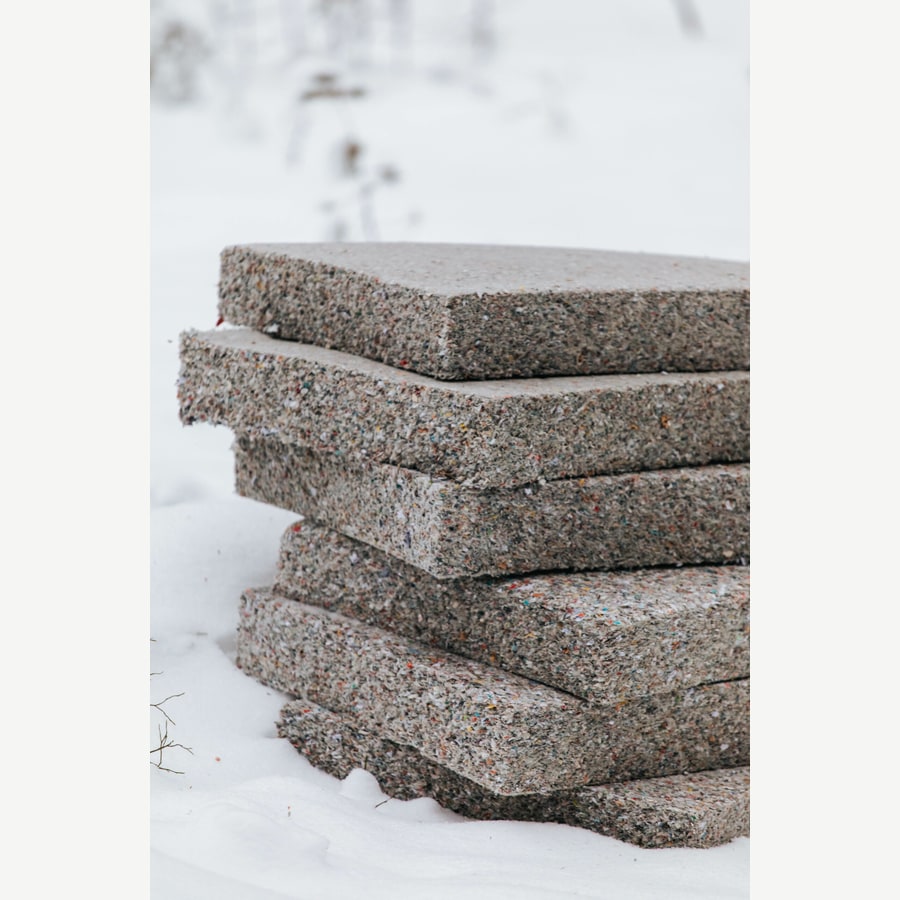
Insulation batts made from sorted newsprint and cardboard with mineral fire-retardant salts — the friction-fit slab version of the blown cellulose that has insulated Finnish timber frames since the 1970s. Cellulose is about the lowest embodied carbon available in an insulant, because the fibre is a waste stream that already exists and the process is milling rather than melting: production is declared net negative once the paper’s stored carbon is counted. It is vapour-open and has high heat capacity, so it also buys decrement delay a lightweight mineral fibre cannot.
Carbon and evidence
Product Evidence
Evidence currently held for the Ekovilla product record.
Recorded Carbon Result
A1–A3 GWP-total per m² at R = 1 m²·K/W (39 mm of this product). Negative because the recycled paper carries more stored biogenic carbon than the milling process emits. The store is not permanent: the same declaration returns +1.81 at C3. Scale it by the R-value actually specified — a 140 mm wall is roughly 3.6× these figures — and do not compare it with a per-m³ or per-kg insulation figure. NOTE: this declaration’s A1–A3 split does not reconcile with its own total (see impacts.gwp.split.reconciliationNote); the total is recorded as declared.
Indicator: GWP-total
Ekovilla Slab (EPD-IES-0008315:002 / S-P-08315)A1–A3 covers raw-material supply, transport to manufacture and manufacturing. It is product-stage information, not a whole-life result.
Environmental Product Declaration
EPD recorded- Coverage
- Specific product
- Declared unit
- 1 m² R = 1 m²K/W, 39 mm, 1.560 kg
- Programme
- EPD International (The International EPD® System)
- Registration
- EPD-IES-0008315:002 (S-P-08315)
- Standard
- EN 15804:2012+A2:2019, ISO 14025
- Valid until
- 2028-07-04
- Verification
- Third-party verified
Ekovilla Slab produced at Kuusankoski, Finland, sold to the European market. Time representativeness 2021, ecoinvent 3.8.
Carbon profile
kgCO2e per 1 m² at R = 1 m²·K/W (39 mm) · each bar starts at zero · local scale
A1-A3 product
-0.546
A4-A5 site*
0.584
B use
—
C end of life
1.82
D reuse / recycling
-1.39
It stores more carbon than is emitted in making it, but the stored carbon is released again at the end of its life.
Reported GWP Modules
Displayed as stored; modules are not added together here.
A1–A3
-0.546 kgCO₂e
per 1 m² at R = 1 m²·K/W (39 mm)
A4*
0.21 kgCO₂e
per 1 m² at R = 1 m²·K/W (39 mm)
A5*
0.374 kgCO₂e
per 1 m² at R = 1 m²·K/W (39 mm)
C1
0.00693 kgCO₂e
per 1 m² at R = 1 m²·K/W (39 mm)
C3
1.81 kgCO₂e
per 1 m² at R = 1 m²·K/W (39 mm)
D
-1.39 kgCO₂e
per 1 m² at R = 1 m²·K/W (39 mm)
Upfront Carbon (A1–A5)*
0.038 kgCO₂e per 1 m² at R = 1 m²·K/W (39 mm)
A1–A3 -0.546 + A4 0.21 + A5 0.374 · GWP-total, as declared
Service Life — the B4 Replacement Input
50 years · EPD reference service life
The declaration states a 50-year design life.
≈2 installations over a 60-year building study period.
Sourced Product Claims
- Made from sorted newsprint, paper and cardboard with mineral additivesThird-party verifiedSource
- Stores 2.33 kgCO2e/m² (at R=1) of biogenic carbon, returned as +1.81 at end of lifeThird-party verifiedSource
- The declaration’s A1–A3 split does not sum to its own declared totalThird-party verifiedSource
- Third-party verified EPD, valid to 2028-07-04Third-party verifiedSource
Evidence Sources
EPD International (The International EPD® System)
Comparison Status
This result should be displayed for information only and not ranked against another product.
- • The EPD is not linked to an evidence source.
Design & Specification Notes
Qualitative notes for early design discussion. Not product-specific EPD evidence, and not a basis for numerical comparison.
Insulation batts made from sorted newsprint and cardboard with mineral fire-retardant salts — the friction-fit slab version of the blown cellulose that has insulated Finnish timber frames since the 1970s.
Typical Uses
- •Thermal envelope
- •Roof/wall cavities
- •Airtightness layers
Key Performance
Good thermal resistance with reduced heat loss.
Specification Actions
- •Compare embodied carbon of insulation options (natural vs synthetic).
- •Request blowing agent GWP values for foam insulation.
- •Confirm the current EPD covers the selected product, finish and manufacturing route.
Indicative Health & Indoor Air
Specification
- Range
- Ekovilla Slab
- Finish
- Cellulose fibre insulation slab
- Density
- 40 kg/m³ (range 32–42)
- Thermal
- 0.039 W/(m·K)
- Service life
- 50 years
- Country of manufacture
- Finland